The Best Times to Trade Forex in Bolivia (Local Hours)
Understanding Forex Market Hours




The Forex market operates on a continuous 24-hour cycle during the business week, driven by the rotation of major financial centers across different time zones. This structure allows traders to participate at almost any hour, but it also introduces significant variation in trading conditions throughout the day. While the market is always open from Monday to Friday, liquidity, volatility, and trading efficiency are not evenly distributed. Recognizing how these factors shift across sessions can help traders refine their timing and improve decision-making.
Unlike centralized exchanges such as stock markets, Forex trading occurs over-the-counter through a global network of banks, institutions, and brokers. This decentralized nature means that activity rises and falls depending on which financial centers are active. As a result, understanding market hours is not just about knowing when trading is possible, but also about identifying when it is most effective.
Forex Market Sessions
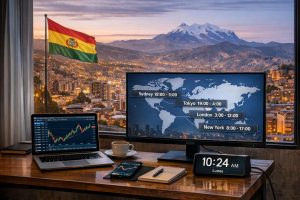
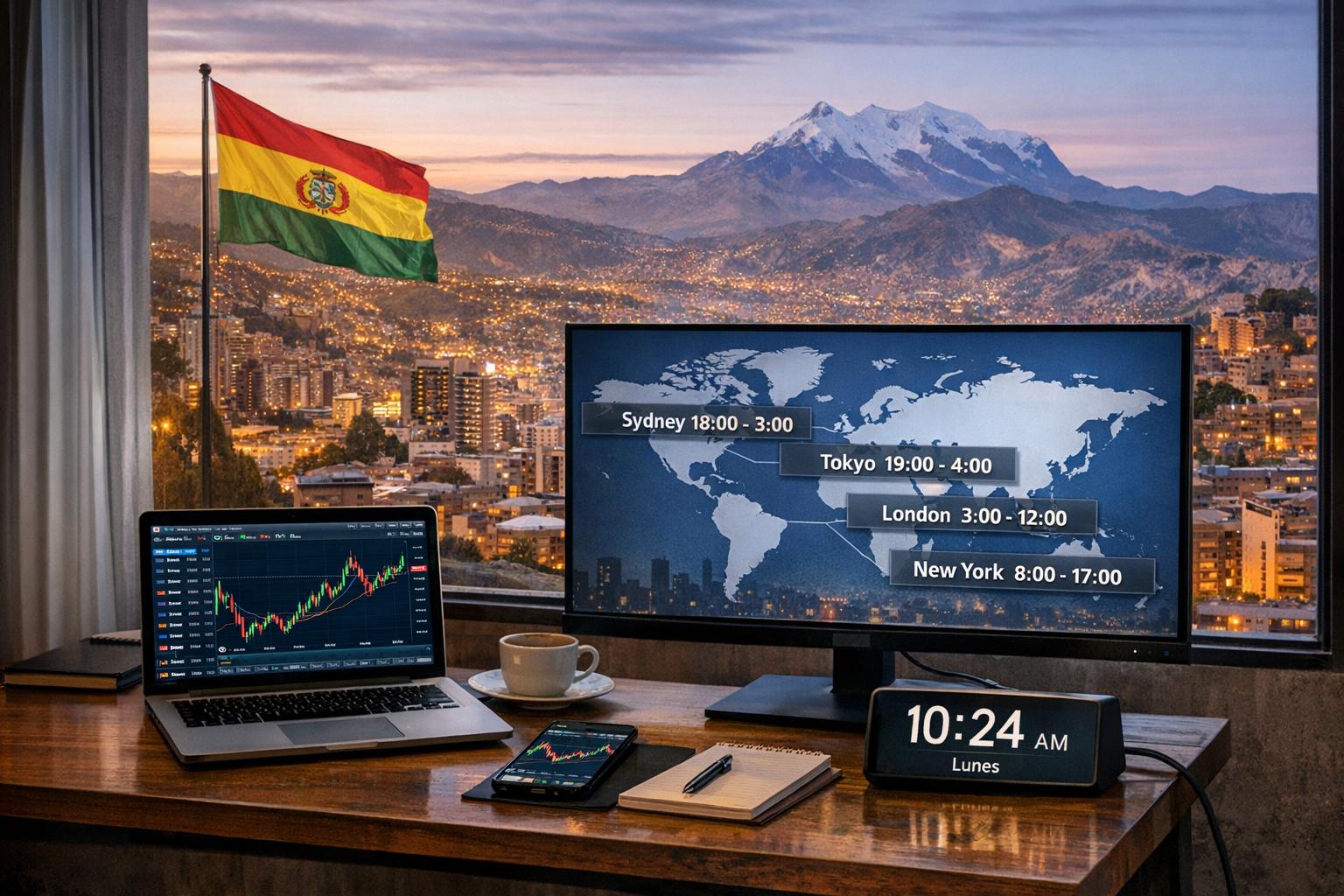
The global Forex market is divided into four primary sessions, each associated with a major financial hub: Sydney, Tokyo, London, and New York. These sessions are not isolated; they often overlap, creating periods of increased trading activity. Each session reflects the economic priorities, institutional participation, and currency focus of its region, influencing price behavior and trading strategies.
The transitions between these sessions are particularly important. When one session ends and another begins, there may be shifts in liquidity and directional bias. During overlaps, multiple regions are active at once, which tends to amplify price movement and create more dynamic trading conditions.
The Sydney Session
The Sydney Session marks the beginning of the Forex trading week. Opening at 10 PM GMT on Sunday and closing at 7 AM GMT, it sets the initial tone after the weekend break. In Bolivia, this corresponds to 6 PM through 3 AM local time.
This session is generally characterized by lower liquidity and reduced volatility. Major institutional players from Europe and North America are not yet active, and trading volume tends to be thinner. As a result, price movements are often more gradual and less erratic. However, this does not mean the session lacks value.
Traders who prefer a more controlled environment may find the Sydney Session suitable for testing strategies or managing existing positions. Currency pairs involving the Australian dollar (AUD) and New Zealand dollar (NZD) are more active during this time, as regional economic data releases can influence price movement. The relatively slower pace can also allow for more deliberate analysis without the pressure of rapid fluctuations.
The Tokyo Session
Following Sydney, the Tokyo Session begins at midnight GMT and ends at 9 AM GMT, corresponding to 8 PM through 5 AM in Bolivia. As Asia’s primary financial hub, Tokyo plays a significant role in shaping early-week market trends.
This session typically offers moderate liquidity and more consistent price action compared to Sydney. While volatility remains lower than in later sessions, it is more structured, which can appeal to traders who rely on technical patterns and range-bound strategies. The Japanese yen (JPY) becomes a central focus, and currency pairs such as USD/JPY, EUR/JPY, and AUD/JPY often experience increased activity.
Economic announcements from Japan, China, and other Asian economies can create temporary spikes in volatility. However, outside of these events, the market tends to move within defined ranges. For traders in Bolivia, this session occurs overnight, which may limit active participation but still provides opportunities for position management or automated trading systems.
The London Session
The London Session is widely regarded as the most influential period in the Forex market. Opening at 8 AM GMT and closing at 5 PM GMT, it runs from 4 AM to 1 PM in Bolivia. London’s status as a global financial center ensures high participation from banks, hedge funds, and institutional traders.
During this session, liquidity increases significantly, and price movements become more pronounced. The market often establishes key trends that may continue into the New York session. A large portion of global Forex transactions occurs during these hours, particularly involving the euro (EUR), British pound (GBP), and US dollar (USD).
The overlap with the Tokyo Session at the beginning adds further activity, while the later overlap with New York creates the most dynamic trading window of the day. Volatility during London hours can present both opportunities and risks, requiring traders to use disciplined risk management.
For Bolivian traders, the early start time may require adjustments to routine, but participation during this session can offer access to some of the most active market conditions available.
The New York Session
The New York Session begins at 1 PM GMT and closes at 10 PM GMT, aligning with 9 AM to 6 PM in Bolivia. As the final major session of the trading day, it carries significant weight due to the economic influence of the United States.
At the start of this session, the overlap with London creates a surge in trading volume and volatility. This period is often considered the most active and liquid time in the Forex market. Major economic releases from the United States, such as employment data, inflation reports, and central bank announcements, frequently occur during these hours and can drive sharp price movements.
As the London Session closes, liquidity gradually declines, and the market may become less active. However, trends established earlier in the day can continue to develop, offering opportunities for traders who follow momentum-based strategies.
For traders in Bolivia, the New York Session aligns closely with standard working hours, making it one of the most accessible and practical periods for active trading.
Strategic Trading Times in Bolivia
For individuals trading from Bolivia, aligning trading activity with the most favorable market conditions is essential. Time zone differences mean that not all sessions are equally convenient or productive. By focusing on periods where liquidity and volatility are balanced, traders can improve the efficiency of their strategies.
Peak Trading Hours
The most active and potentially advantageous period occurs during the overlap between the London and New York sessions. In Bolivian local time, this window runs from approximately 9 AM to 1 PM. During these hours, both European and North American markets are fully engaged, resulting in a concentration of trading activity.
This overlap is characterized by tight spreads, high liquidity, and strong price movements. For day traders and short-term participants, these conditions can support rapid execution and more frequent opportunities. Breakouts, trend continuations, and sharp reversals are all more likely to occur during this time.
However, increased activity also requires careful management of risk. Price swings can be significant, and unexpected news events may trigger sudden market reactions. Traders should be prepared with clear entry and exit criteria to navigate these conditions effectively.
Invest in Preparation and Analysis
Active trading periods represent only one part of a broader trading process. Time spent outside peak hours can be equally important for long-term success. Preparation involves reviewing market structure, identifying key support and resistance levels, and monitoring upcoming economic releases.
Developing a structured approach to analysis can help traders operate with greater consistency. This includes evaluating historical price behavior, assessing correlations between currency pairs, and understanding macroeconomic influences. By entering active sessions with a defined plan, traders can reduce reliance on impulsive decisions.
Additionally, maintaining awareness of global economic calendars ensures that traders are not caught off guard by high-impact news events. These releases often coincide with session openings or overlaps, amplifying their effect on market behavior.
Adjust According to Market Dynamics
The Forex market is influenced by a wide range of factors, including economic data, central bank policies, and geopolitical developments. While session timing provides a useful framework, it is not absolute. Market conditions can shift unexpectedly, creating opportunities or risks outside typical patterns.
For example, major announcements from central banks may occur outside peak trading hours, leading to sudden increases in volatility. Similarly, geopolitical events can disrupt established trends and alter market sentiment. Traders should remain flexible and avoid relying solely on fixed schedules.
Adapting to changing conditions may involve adjusting position sizes, modifying trading strategies, or temporarily stepping back during periods of uncertainty. A responsive approach allows traders to remain aligned with current market dynamics rather than outdated assumptions.
Risk, Liquidity, and Timing Considerations
Understanding Forex market hours also requires attention to how liquidity and risk interact across different sessions. During high-liquidity periods, such as the London-New York overlap, trades are typically executed بسرعة and with minimal slippage. In contrast, quieter sessions may involve wider spreads and less predictable price behavior.
Timing also influences the effectiveness of different trading styles. Short-term traders often benefit from high activity, while longer-term participants may place less emphasis on precise entry timing. Recognizing this distinction helps traders align their approach with suitable market conditions.
It is also important to consider that not all currency pairs behave identically across sessions. For instance, pairs involving Asian currencies may be more active during the Tokyo Session, while European pairs gain momentum during London hours. Aligning trading focus with session-specific activity can improve efficiency.
Conclusion
The structure of Forex market hours reflects the global nature of currency trading. While the market remains open continuously during the workweek, the quality of trading opportunities varies throughout the day. For traders in Bolivia, understanding how each session aligns with local time provides a practical advantage.
The overlap between the London and New York sessions stands out as the most active and liquid period, offering conditions that support efficient trading. However, success is not determined solely by timing. Preparation, adaptability, and disciplined execution remain critical components.
By combining an awareness of market sessions with consistent analysis and risk management, traders can approach the Forex market with greater clarity and effectiveness.
This article was last updated on: July 3, 2026