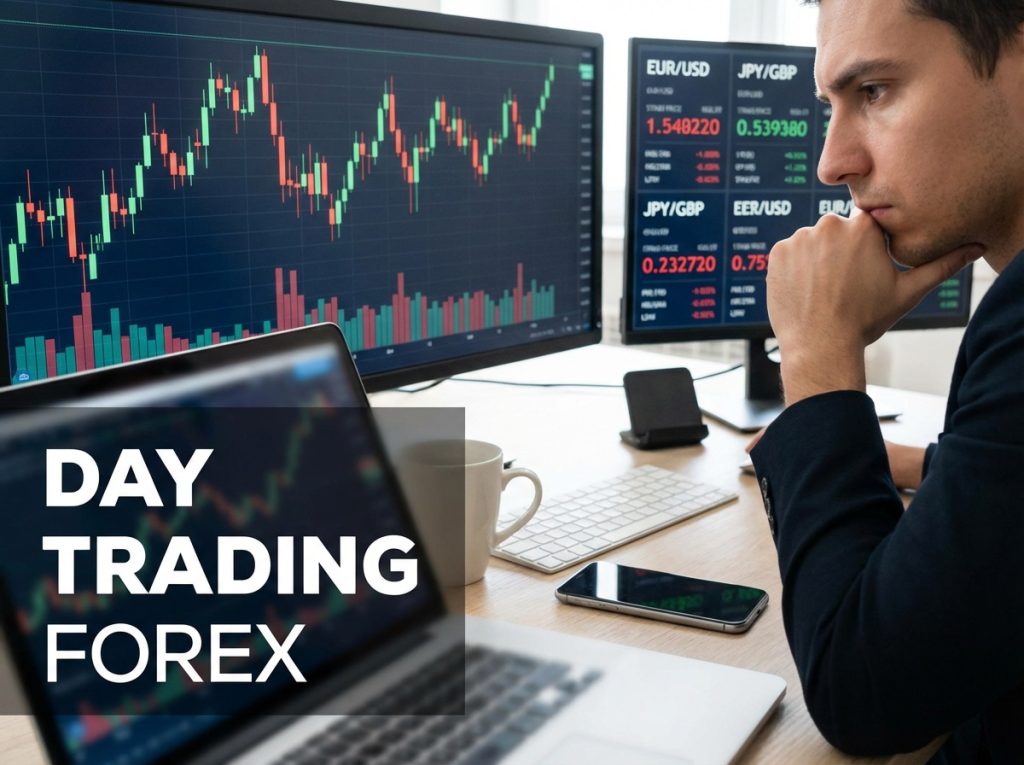
Day trading on the forex market is short term speculation on currency pairs where positions are opened and closed within the same day. You are not trying to ride multi week macro trends or hedge corporate exposure. You are trying to pick small moves, often measured in a few pips to a few dozen, and repeat that through the session.
Most retail day traders work through margin accounts at online brokers that quote tight spreads on major pairs and offer high position multipliers. The combination of large notional exposure on small price moves is what makes forex day trading feel fast and sometimes a bit addictive. It is also the reason regulators keep reminding people that a high share of retail accounts lose money in this area. Across a wide sample of European brokers, disclosures usually say that between 70 and 85 percent of retail clients lose money when trading forex and CFDs.
If you approach it as a structured business, with clear rules and moderate expectations, forex day trading can be one part of a wider trading activity. If you treat it like a quick fix for cash problems, the market tends to teach that lesson in a fairly harsh way.
This article will focus on the trading of the forex market. If you want to learn more about how day trading works on other markets, then I recommend you visit DayTrading.com. Daytrading.com feature thousands of articles and guides on all different types of day trading.
How the forex market is structured and why that matters for day traders




The foreign exchange market is an over the counter network rather than a single centralised exchange. Large banks quote prices to each other and to brokers. Electronic communication networks match flows. Retail traders see a thin layer on top of that, through their broker platform.
Major currency pairs like EURUSD, GBPUSD and USDJPY are the most liquid. They have tight spreads, deep order books and trade through almost all hours of the week. Minor and exotic pairs can move sharply but usually with wider spreads and patchy liquidity. That means slippage hits harder when you try to enter or exit size during fast moves.
For a day trader, this structure has a few consequences.
There is no official single “price”, just a stream of quotes. One broker may show a slightly different tick history compared with another. Backtests can look perfect on one data feed and less impressive on another. Execution quality depends on the broker’s routing, their relationship with liquidity providers, and whether they internalise flow.
On top of that, your position is nearly always against a much larger, more informed pool of traders. Institutional desks, high frequency firms and large funds use the same pairs but with better data and order flow information. The math is not hopeless, but it does mean your edge has to come from good trade selection, discipline and careful control of costs, not from trying to out click a bank desk.
Trading instruments and broker types used for forex day trading
Retail forex day traders use a few main instruments that all track the same underlying currency pairs.
The first is spot forex through a margin account at a retail broker. Here you are trading contracts that mirror interbank spot prices, with tight spreads and overnight financing charges on positions held after a certain time. Most day trades are flat before then, so financing is less of an issue.
The second group is contracts for difference on forex pairs. These behave like spot in many ways, but are legally a different type of contract. They are widely used in Europe and other regions. Regulators such as the European Securities and Markets Authority (ESMA) have focused on CFDs in their warnings, again because most retail accounts lose money.
You also have futures contracts on currencies, traded on exchanges like CME, and options on currency futures or spot. Many full time intraday traders work through futures because of centralised pricing, clear margin rules and a transparent order book. The barrier is a slightly higher capital requirement and the learning curve around contract specs.
Broker type matters. Some brokers run a dealing desk and may internalise client trades, while others pass orders straight through to outside liquidity providers. Well regulated brokers also publish the percentage of clients who lose money, as required in regions under ESMA rules, and usually carry clear risk warnings.
From a day trader’s point of view, the right instrument is usually the one that offers reliable execution, honest pricing, and low enough costs that your edge does not get eaten before it reaches your account.
Costs, spreads and execution quality
Every forex day trading strategy lives or dies on transaction costs. If you chase three or four pip moves but pay two pips in spread and commission, there is not much left on the table.
Costs show up in a few areas. The first is the quoted spread between bid and ask. Major pairs in active sessions may show extremely tight spreads, sometimes below one pip. Exotic pairs might be many times wider. The second is commission per trade, either baked into the spread or charged separately. High frequency strategies feel this very quickly.
Then there is slippage. That is the gap between the price you saw when you clicked and the price you actually received. In quiet markets, this is tiny. Around data releases, thin liquidity or sudden shocks, it can be large enough to change the whole economics of a trade.
Regulators have repeatedly found that a high proportion of retail clients lose money on forex and CFD products, and high trading costs are one of the reasons given alongside poor risk control. ESMA’s product intervention analysis on CFDs highlighted high cost and complexity as key drivers of losses for retail investors.
The uncomfortable but honest way to look at this is simple. Before you fantasise about doubling an account, you need to know, in numbers, what you pay per million traded, how that interacts with your hit rate, and how much room that leaves for profit after the house takes its cut.
Sessions, volatility and intraday behaviour
The forex market runs almost twenty-four hours from Monday to Friday, but it does not behave the same way all the time. Different sessions have different personality quirks.
The Asian session tends to be quieter on many majors, with tighter ranges and lower volume, except for yen and some regional pairs. The London session wakes things up, with strong flows in EUR, GBP and the main crosses. The New York session overlaps with London and often sees the sharpest intraday swings, especially around US economic data and equity open.
Day traders often focus on one or two sessions that suit their timezone and temperament. Some prefer the slow grind of the early Asian hours to quietly test setups. Others want the chaos of the London or New York open, where price can travel a large share of its daily range in an hour.
Volatility is not just about how far a pair moves per day. It is also about how it moves. Some days have smooth trends where pullbacks hold obvious levels. Other days show choppy two way action that eats stops on both sides. Indicators like average true range give a basic handle on recent ranges, but screen time and journals tell you more about how your style copes with each type of day.
When you combine this behaviour with the margin available in forex accounts, you can see why so many day traders get flushed out quickly. A 40 pip swing against an oversized position in the New York session can blow away an account that survived weeks of gentle Asian ranges.
Common day trading styles on forex
Forex day traders usually end up in one of a few broad camps, even if they would never admit the label.
One camp is scalpers. They hunt for very small moves, sometimes just a handful of pips, near short term levels. They might use one minute or tick charts, depth of market tools or order flow indicators to time entries. The fast pace is exciting, but it means many trades per day and a heavy load of transaction costs. If your win rate drops a little or your average win shrinks, you can fall behind very fast.
Another camp is intraday swing traders. They use higher intraday time frames such as fifteen minute or hour charts to frame a bias, then drop down a bit for entries. The goal is to catch a meaningful chunk of a move that plays out over several hours. They may aim for two, three or more times their stop size in profit. Trade frequency is lower, but stress can be higher, because you watch positions swing up and down while price grinds its way to target or stop.
Then you have news traders. They focus on economic releases, central bank speeches and political headlines. Some trade the spike itself, trying to guess the surprise relative to expectations and the initial reaction. Others fade over reactions, betting that once the dust settles price will drift back toward pre news levels. This style demands fast data, quick decisions and a strong stomach, because spreads widen and slippage grows around those announcements. Regulators such as the UK Financial Conduct Authority keep reminding retail traders that high risk products combined with hype on social networks around news trading can lead to heavy losses.
A quieter group focuses on range and mean reversion setups. They map out support and resistance zones on the day and look for price to bounce between them, fading moves near the edges when order flow dries up. This can work well in slow conditions and fail badly on strong trend days. The art is knowing when the day looks range bound and when it looks like a one way freight train.
There are dozens of named strategies online, often wrapped in flashy marketing. Under the surface they are mostly variations on these basic themes. What matters is not the label but whether the style fits your personality, capital, and schedule, and whether your numbers, after costs, show any real edge at all.
Risk and money management for intraday forex trading
Risk control is the part almost everyone nods along with on Sunday and then quietly ignores on Wednesday after three losses.
Position sizing is the first line. Many experienced traders risk a small fixed slice of account equity per trade, often around one percent or less. That does not make you safe by itself, but it slows the damage and gives you a big sample of trades before the account is in real trouble.
Stop placement is the second. A good stop is not just a random number of pips. It is placed where your idea is wrong. If you are buying a pullback in an uptrend, that might mean under the last higher low or under a clear support zone. If you are fading a range edge, it might be beyond the level where previous bounces failed.
Reward relative to risk matters as well. Many day traders aim for average wins at least as large as losses, often larger. That way, even if you have a modest hit rate, the math can work in your favour. Research using regulatory data across forex and CFD brokers shows that only about 25 to 30 percent of retail accounts are profitable in a given quarter, and the share of people who make a stable living from trading is far lower.
That data is not there to depress you. It is there as a warning that you do not get to sidestep basic math. Oversized positions, random stop placement, and weak reward to risk ratios are exactly what fill the losing 70 to 80 percent bucket regulators keep talking about.
Psychology traps that crush forex day traders
Forex day trading compresses emotional swings into hours. You can go from calm to euphoric to furious before lunch, and that is before the US data releases hit.
One common trap is revenge trading. You take a planned loss. Instead of logging it and waiting, you jump straight back in, sometimes in the same direction, sometimes flipped, with larger size. The goal in your head is to “get back” what the market just took. The market does not care, of course. You end up trading your frustration, not your plan.
Another trap is overconfidence after a run of wins. A string of good trades in a trending week can feel like proof that you finally cracked the code. Position size quietly grows, rules get a little looser, and then a choppy week hands all that profit back, plus a bit for good measure.
Social media does not help. Screenshots of huge one day gains, often from high risk accounts, set weird expectations. You rarely see the same accounts post when they blow up weeks later. Regulators in multiple countries have started warning about “finfluencer” promotions in forex and CFD markets for exactly this reason, noting cases where tens of thousands of investors lost large sums following tips and copy trades from unregulated promoters.
The practical fix is boring. Set firm daily loss limits and stick to them. Build habits away from the screen so your whole mood does not depend on whether EURUSD ticked your way this morning. Talk about trading with people who do not glamorise blowing accounts for content.
Building a routine and a simple day trading plan
A decent forex day trading plan fits on a page. If you need a binder, something is wrong.
You start by defining which pairs you trade and at what times. Maybe your window is the first three hours of the London session on EURUSD and GBPUSD. Maybe it is the New York session on a dollar index and one or two majors. The more focused you are, the easier it is to collect useful data.
Next is your setup description. That is a plain language explanation of what you need to see before you take a trade. For a trend follower, that might include a higher time frame up move, price above a moving average band, and a clean pullback to a prior level. For a range trader, it might mean at least two touches of support and resistance, decaying momentum, and no major news scheduled in the next hour.
Then you write down your entry triggers, stop rules, and exit logic. Entry could be a candle pattern at the level, or a break and quick retest. Stops go where the idea fails. Exits might be at fixed multiples of risk, at nearby levels, or based on time in trade.
Finally you wrap risk limits around the whole package. That means your maximum risk per trade, maximum number of trades per day, and daily stop where you shut the platform and go do something else. It also means how you will review the day. A simple journal with screenshots and a few notes is enough. Over a few months it tells you far more about your behaviour than your memory does.
Where forex day trading fits in a wider portfolio or career plan
Forex day trading does not have to be your whole investing life. For many people it makes more sense as a small, ring fenced activity next to longer term investing or other income.
If you have a main job, the time windows you can trade are narrower. That can be a hidden advantage. You are forced to pick one or two sessions and avoid random screen staring in the middle of the night. Your position size also probably needs to be smaller relative to your net worth, which again cuts the odds of emotional meltdowns.
If you are moving toward full time trading, then forex day trading is just one candidate among others. Futures on equity indices, options strategies, or even swing trading on higher time frames may fit your temperament better. The decision should be based on live and demo data, not on which area has the loudest marketing.
For investors who mainly care about building wealth slowly, day trading forex may not fit at all. The required time, focus, and emotional wear and tear are high compared to simple diversified portfolios or even calmer swing trading.
Short wrap up
Day trading on the forex market can feel simple on the surface. Two currencies, a chart, some levels, and a buy or sell button. Under that surface sits a professional market, high failure rates for retail traders, and a set of psychological and mathematical traps that do not forgive casual mistakes.
If you decide to do it, treat it like a serious small business. Know your costs, write your rules, keep your risk small, and let your data tell you whether you have even a small edge. If those numbers stay red after a fair trial, the bravest move might genuinely be to step back and direct your time and capital somewhere kinder.
This article was last updated on: February 24, 2026